Overview
In Ghana there are thousands of auto-mechanic shops set up for the repair and maintenance of automobiles. At these shops, the mechanics are exposed to toxic heavy metals in the used motor oil due to misuse and mismanagement of the used oil. Heavy metals find their way into the body and to the blood stream via dermal contact, ingestion, or inhalation, and are known to cause cancer; kidney, liver, and brain damage; negative reproductive and birth defects; and diminished learning ability in children; among others. In addition, the used oil is improperly disposed onto the bare soil resulting in the heavy metals finding their way into streams and drinking water aquifers, degrading soil quality and the ecosystem, and posing a threat to posing a threat to the environment and food security. In addition, the mechanics are not aware of health consequences of such occupational exposures and work with no PPEs.
Prof Fred Boadu and a Duke Bass Connections team visited mechanic shops in Ghana in 2017/2018, interviewing over 150 mechanics, collecting hair and nail samples to analyze for heavy metal concentrations, and recording blood pressures to assess any associations between heavy metals in the body and blood pressure. The team found that mechanics who have worked more years (>5 years) tend to have higher concentrations of various heavy metals (Cr, Ni, Cd, Mn and Fe) in their systems, with attendant higher blood pressure levels. During the interviews, it became clear that the mechanics were not aware of the dangers their practices pose to their health, the environment and food security. Thus, there is an urgent need to provide community education and create awareness of these health and environmental risks in an effort to promote behavioral changes with regards to the mismanagement of used motor oil by the mechanics. This will be a highly needed and valuable effort to protect the environment, valuable groundwater resources, and food safety, and mitigate the risks to human health and save lives.
Community Partnership(s)
Duke students will be engaged in an educational and awareness campaign effort pertaining to the mismanagement of used oil and consequent destruction of the environment, putting health of the auto-mechanics at risk and threatening food security. We propose to visit over 200 auto mechanic shops, each with at least 6-9 (employees) apprentices. Presently, there are no enforced regulations on the use, management or disposal of used motor oil. The objectives are to educate and create awareness pertaining specifically to those in the auto repair and maintenance that:
- Used motor oil contains toxic substances that can be concentrated and find their way into drinking water and pose a health threat to humans who drink it. Also, a threat to food security via plant uptake of the heavy metals.
- Mismanagement and misuse of waste motor oil can seriously affect human health, compromise food security, contaminate groundwater and degrade the ecosystem.
- Used motor oil can be recycled, re-refined and processed for re-use.
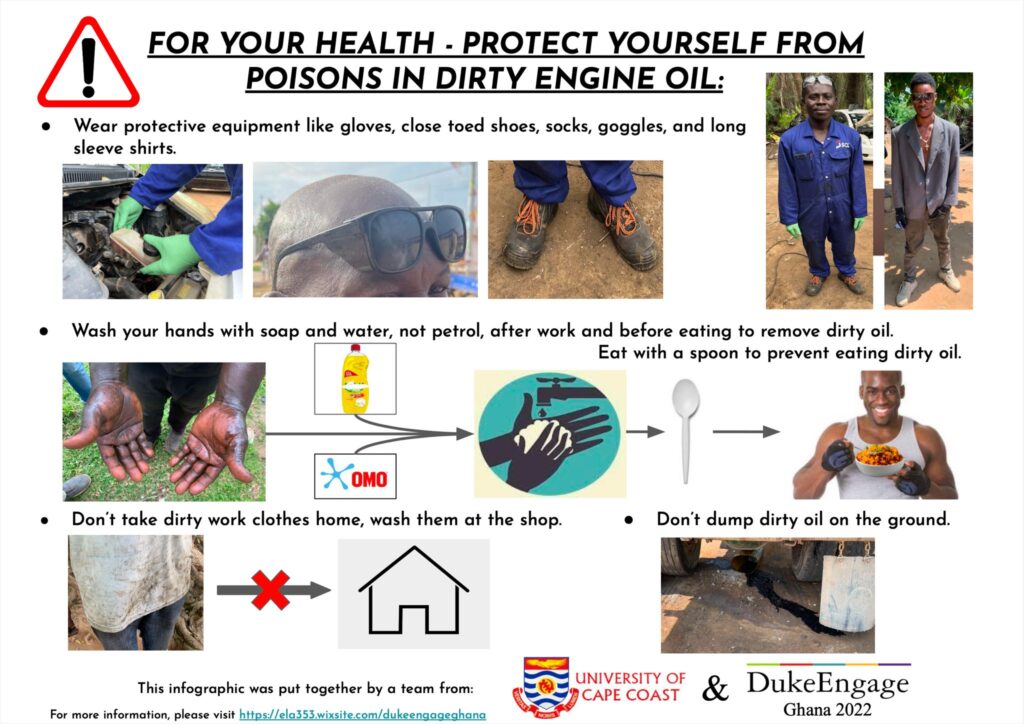
- Direct skin contact with motor oil over an extended period of time can cause cancer, kidney and liver damage; thus, skin should be protected with gloves, masks and long sleeves.
The above objectives will be achieved by executing the following tasks:
- Task 1. Engage with representatives of the mechanics’ village and local government officials to announce the visit of Duke Team with the mission to educate, create awareness and share their knowledge with them with regard to the impact of mismanagement and misuse of motor oil on human health, groundwater, environment and food security.
- Task 2. Possibly visit nearby high schools and engage pupils in classroom discussions to educate them on the impact of used motor oil on human health, environment and food security. We will encourage them to pass on the knowledge gained to their parents and households.
- Task 3. Interact with auto-mechanics in a culturally sensitive manner to share knowledge about protection of groundwater, environment, and health. Students will engage in shop-to-shop visits. The team will be split into two to execute these tasks.
- Task 4. Discuss waste management plans and introduce the idea of proper disposal of used motor oil via recycling, re-refining and process recovery for re-use.
Program Requirements
Personal Qualities: It is useful to have students with an interest in or passion for addressing global societal challenges, in particular disadvantaged socioeconomic groups. This will most likely inspire the next generation. In addition, students should respect other cultures, language barriers, etc. of Ghanaians they interact with. Students should be willing to adapt in new environments and follow timelines (dining, work, etc.). No language or course requirements.
Logistics
Housing, meals, and transportation:
Students will likely stay in a guesthouse on the campus of Kwame Nkrumah University of Science and Technology (KNUST), relatively closer to the field/work site. Breakfast, lunch and dinner will be provided at the residence, and students will take packed lunch to their work sites if needed. The Ghanaian nutrition is dominated by animal-based products (fish, meat, poultry) with rice (jollof, fried rice waakye), banku (maize based). Whilst in the past we have accommodated vegans, we have faced challenges with variety of vegan diets. Halal foods/diets are extremely limited and challenging to provide.
There are certain times when it might rain (we will be in the tail end of the rainy season when we get there), or when the mechanics we are scheduled to meet may have emergency and cannot meet that day. In these circumstances students may continue to analyze gathered data or go play some sports etc. per set rules and regulations that will be discussed during pre-departure briefings.
One thing to be aware of is — this program has a bit more structure around movement, especially in the evenings and nights. For safety and cultural reasons, students are generally expected to stay with the group or within designated areas. If you’re someone who really values independent exploration at night, that’s something to keep in mind.
Local safety, security, and cultural norms: We encourage students who have questions or concerns about health or safety in international programs to check Duke’s International SOS (ISOS) portal for relevant information. If you have special needs related to health, culture, disability, or religious practices, please contact the program director(s) or the DukeEngage office to discuss whether your needs can be accommodated in this program.
For guidance on how race, religion, sexual/gender identity, ability, or other aspects of identity might impact your travels, we suggest exploring the Diversity, Identity and Global Travel section of the DukeEngage website.
Academic Connections
This program is open to all, and might especially appeal to students in Environmental Sustainability and Environmental Science and Engineering, Global Health, Sciences, Public Policy, pre-med (medical sciences), as well for students who want to use their education for global societal challenges in a humanitarian context.
DukeEngage cannot guarantee that any program will occur. Dates and program details are subject to change, and programs may be cancelled for various reasons, including geopolitical or public health issues.
Student Reflections from 2022
-

Oil and trouble: Reflections from Ghana
Published by Harrison Chen & Chinomnso OkechukwuDukeEngage Ghana students led educational and awareness efforts in Cape Coast this summer regarding the harmful effects of used motor …Read more