APPLY TO DUKENGAGE BOLIVIA
Information Session:
- For more information, please contact Professor Schaad.
Overview
Bolivia is a landlocked country located in central South America. The country features diverse geography, including Amazonian plains, tropical lowlands, mountains, high-altitude Andean plateaus, and snow-capped peaks, encompassing a wide range of climates and biomes across its regions and cities. It is bordered by Brazil to the north and east, Paraguay to the southeast, Argentina to the south, Chile to the southwest, and Peru to the west.
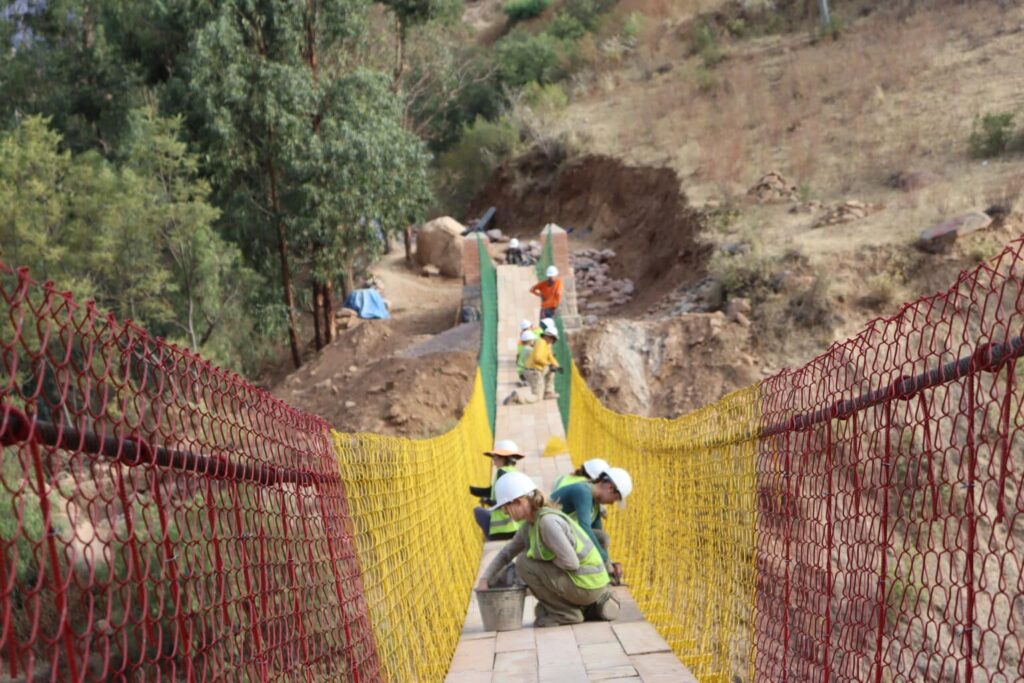
Participants will work alongside the international nonprofit Engineers in Action (EIA), local governments, and local community members to build a suspended pedestrian bridge in a rural Bolivian community. This project supports the community’s active participation in its own development and will help to provide safe, year-round access to education, health, and economic opportunities.
Prior to travel, students in this program will have the opportunity to learn about the engineering design process for suspended bridges and work on the design of the bridge that the team will construct with the support of Dr. Schaad, EIA, and professional engineer mentors.
While in-country, students will specialize in one or more of the following roles: project management, design, construction management, quality control, safety, logistics, cultural relations, and media.
Community Partnerships
Students in this program will work in collaboration with the staff of Engineers in Action (EIA), local masons, and construction workers to build a suspended pedestrian bridge. Duke Engineers for International Development (DEID) has teamed with EIA for multiple years in Eswatini, Rwanda and Bolivia, designing and constructing bridges in similar settings in each of those countries.
The student designs will be conducted during the spring semester as part of EGR190 (Engineering Design in Community Context) or an independent study project. All accepted DukeEngage team members will be expected to participate in the design process (with guidance from Dr. Schaad).
The bridge will be constructed to empower local farmers to get their crops to market, enable local school children to access educational opportunities, and allow efficient and safe transport for health emergencies.
Program Requirements
Coursework: The design for the projects will be developed by students enrolled in the spring course EGR190 (Engineering Design in Community Context). Enrollment in the class is recommended, but not required, to be part of the DukeEngage program during the summer of 2026. Students not enrolled in the class must enroll in a half-credit (group) independent study where the team will collaborate in the design effort overseen by Dr. Schaad.
Language: Participants are not required to speak any level of Spanish, however, most communication with on-site EIA staff and community members will occur in Spanish. Students without fluency are still encouraged to apply.
Personal Qualities: A willingness to work hard and live in Spartan conditions.
Logistics
Housing, meals, and transportation: Students will live within the community where they are working, in tents and/or simple buildings (concrete floor, CMU walls, thatched roof, pit latrine typical). Upon arrival in Bolivia, students will do their initial grocery shopping and orientation alongside EIA staff before heading to the site. We are planning for cooks to prepare meals, many of which feature rice and beans – with meat on occasion. Students will walk to the work site, and other local transport will most often be on the public transportation system (passenger vans, small buses, etc.). Students should prepare to have limited access to cell service during the project.
Local safety, security, and cultural norms: We encourage students who have questions or concerns about health or safety in international programs to check Duke’s International SOS (ISOS) portal for relevant information. If you have special needs related to health, culture, disability, or religious practices, please contact the program director(s) or the DukeEngage office to discuss whether your needs can be accommodated in this program.
For guidance on how race, religion, sexual/gender identity, ability, or other aspects of identity might impact your travels, we suggest exploring the Diversity, Identity and Global Travel section of the DukeEngage website.
Academic Connections
This program is open to all and might especially appeal to students who want to fulfill requirements associated with their Global Health major or the Global Development Engineering Certificate.
DukeEngage cannot guarantee that any program will occur. Dates and program details are subject to change, and programs may be cancelled for various reasons, including geopolitical or public health issues.